How To Propagate Monstera
The Easy Way
Learning how to propagate plants is a necessary skill for any plant parent. These instructions will be specific to Monstera Deliciosa, but can be applied to any plant with a similar structure. Of course every plant is different and some varieties are more prone to root rot than others (ahmm Thai Constellation), so always use your best judgment.
Q. What Is Propagation?
A. Plant Duplication
Propagation is the process of creating a “clone” of the original plant by cutting off a piece and making it its own plant.
Merriam Webster defines it as…
Increase (a kind of organism) in numbers
Q. Why You Should Know How To Propagate?
A. To Share
Propagation is a great way to share the joy of gardening. You can gift plants to your friends and family, and help them start their planty collection.
One of my first plants was a Pilea Peperomioides also known as a Friendship Plant.
A. To Sell
You can trade props of your current plants for new ones. This can be a great way to grow your collection without spending any money, or obtain rare plant cuttings.
A. To Grow
This can also be a useful skill if your plant gets a little wonky, and you just want to start over. Sometimes a plant can get too big, weird, or ill, and it’s easier to start fresh with a prop (short for propagation). After all, all the fun is watching them grow!
With this valuable skill you can duplicate your plant to share, sell, trade, or grow.
Q. Is Monstera Easy To Propagate?
A. Yes
Monsteras are typically easy to propagate. They have thick strong roots that grow rapidly from easily visible nodes. I’ve had success using water, perlite, and leca to do this.
Q. How to Propagate Monstera Deliciosa?
A. Follow the three steps below:
Look for nodes and cut
Root cutting
Transfer to soil
Q. How To Find Nodes?
A. Look for a bump on the stem
You will see a bump on the main stem. That looks like this:
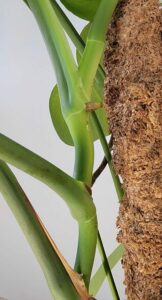
This bump may look like a small root poking out. You’ll want about an inch of stem around this area. This is where the new roots will grow from. You’ll want about an inch or two around this area.
Q. How To Cut Monstera?
A. Using Clean Sharp Scissors
I like to use bigger scissors for Monstera Deliciosa because it can be a pretty thick stem. I user smaller clippers like this for all my smaller plants. Make sure to leave an inch or around the node when you cut.
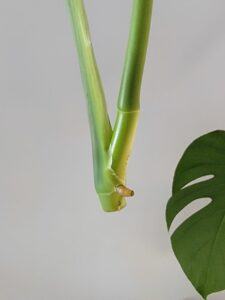
You now have an unrooted cutting. This is a very precarious state for your plant because it does not have any roots. Roots hydrate and ground your plant. Your job now as a plant parent is to encourage root growth.
Q. What Do I Put The Cutting In?
A. Water, Leca, Perlite, or Pumice
You’ll want to create a moist environment with water and air.
I have had great success by simply placing the cutting in a glass of water and using additional substrates like leca, perlite, and pumice.
Perlite and leca are substrates that increase oxygen supply to the plant’s root system. This will also help your plant transfer to soil more easily.
Q. How To Root With Water?
A.
Fill a jar with just enough water to cover the node area. Place your cutting in the jar, find a sunny spot, and wait.
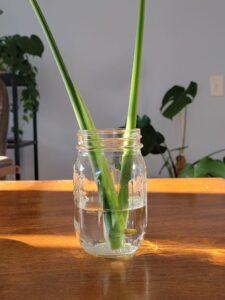
Make sure your plant is in a sunny window so that it has lots of energy to grow. The roots grow pretty rapidly, and you should have a significant amount after a few weeks. Once there’s enough you can pot it into soil or transfer to a more permanent hydro setup.
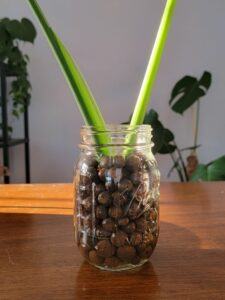
Q. How To Root With Leca or Perlite?
A. With A Jar
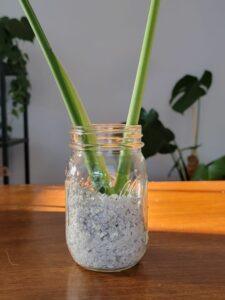
A. With An Orchid Pot
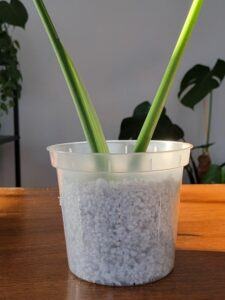
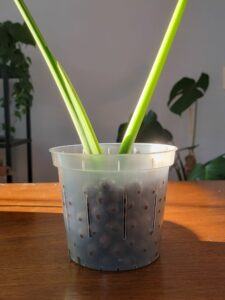
Follow the above directions for rooting with perlite or leca (substrate).
Rinse the substrate well, and consider wearing a face mask if you are sensitive to dust.
Fill your orchid pot ⅓ full with the substrate, position your plant in the pot, and fill to the top. Thoroughly rinse with water. Some of the smaller pieces may fall out of the pot, but this is fine, just make sure to have a way to stop it from going down the drain.
Place it in your cover pot. Add water until it is about ½ way up the orchid pot when submerged in water.
Flush the substrate and change the water about once a week, and roots will start growing over the next few weeks.
Q. Is Sphagnum Moss Good For Rooting Plants?
A. Sometimes
Many people also root with sphagnum moss, but I’ve had mixed results so I’ll focus on methods that work really well for me.
Q. Rotting?
A.
As your plant is rooting you’ll want to be on the lookout for rot, and if it appears cut it off. It will be brown and VERY mushy. You can avoid this by flushing the water regularly (1x a week).
Q. Can I Leave My Plant In Water Forever?
A. Not, Unless You Supplement Nutrients
It will be fine in water for some time, but it won’t have the energy to put out large new grown, and will eventually become a zombie and die. You can keep it in a permanent hydroponic system by using and leca and added nutrients like these.
Q. How Do I Transfer To Soil?
A. With An Airy Soil Mixture And Consistent Watering
I like to use an airy soil mixture. This can be done by combining large, chunky pieces into your soil base and additives (orchid bark , charcoal, pumice, etc.).
You’ll want to make sure to keep the soil a little extra moist the first week or two after you plant it. You can find all my favorite products for soil on my favorites page.
Now you have a new plant!
Give the plant a couple weeks to settle in, and it should be right on its way to growing big and strong. This is a plant you can now grow, trade, gift, sell, or whatever your heart desires.
Happy planting!
Disclosure: PlantyFriend.com may get commissions for purchases made through links on this website. Don’t worry though, we only post links to items we love!